Commencement History
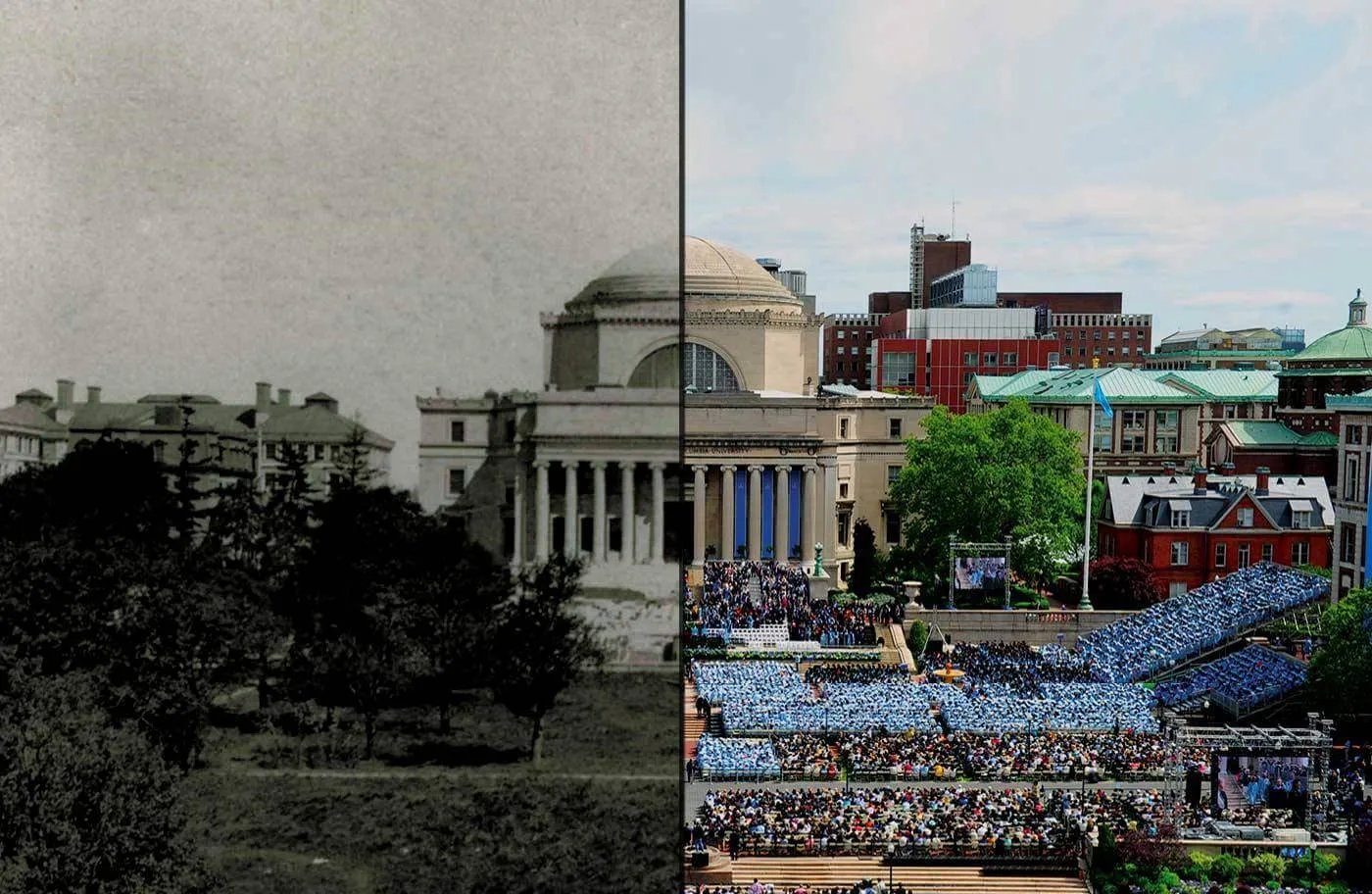
Left image: 1897, Right image: 2015
Columbia’s Commencement Story
Each May, Columbia University gathers to celebrate its graduates in ceremonies that bring together students, families, faculty, and friends from across the world. The ceremony, rich with tradition and history, connects today’s students with generations of Columbians who came before them, celebrating scholarship, community, and pride.
A Celebration That Evolves Over Time
Columbia Commencement has evolved alongside New York City itself. In the 1700s, graduates marched from Park Place to Trinity Church in downtown Manhattan. By the mid-1800s, the celebration had moved uptown to the Academy of Music at 14th Street and Irving Place. Since 1898, the University has called the Morningside campus home, first hosting Commencement in the University Gymnasium and, beginning in 1926, outdoors on Low Plaza. Throughout its history, Commencement has adapted to meet the needs of a growing University while preserving the spirit that makes this Columbia's most anticipated day of the year. In 2026, Columbia introduced a new Commencement structure with two ceremonies: one for graduate degree candidates and one for undergraduate degree candidates.
The Story Behind the Regalia
Academic dress dates to medieval Europe, when scholars wore long gowns and hoods for warmth in cold, stone buildings. Over time, these garments became lasting symbols of scholarship and tradition. When King’s College (now Columbia) was founded in 1754, it followed those early British customs. Ceremonies were held in Latin, and classical orations were a highlight. The tradition has evolved, but the connection to history remains.
How Columbia Helped Set the Standard
Columbia stands out proudly with its own twist and tradition with our signature Columbia Blue gown. It’s one of the few universities granted an official exception to the national black gown standard.
Doctoral gowns: Black velvet panels and sleeve chevrons, embroidered Columbia crowns at the chest, and an eight-cornered velvet tam with a gold tassel.
Master’s and bachelor’s gowns: Light blue robes with small Columbia crowns at the chest. Undergraduate and Master’s graduates do not wear hoods. Master’s graduates wear robes with oblong sleeves.
Hoods (doctoral): Lined with Columbia’s light blue and white, and edged in the colors of the graduate’s academic field: dark blue for philosophy, golden yellow for science, white for the arts, and more.
The University Mace
At the front of the Academic Procession, you will see a silver mace gleaming in the sunlight. This eighteenth-century piece, crafted of Sheffield plate and crowned with acanthus leaves, was given to the University by Judge John Munro Woolsey (LLB. 1901, LL.D. 1929). Once a symbol of authority in British courts, the mace now represents Columbia’s enduring leadership and the centuries of scholarship carried forward at every Commencement.